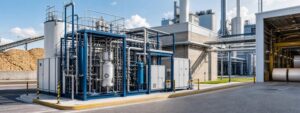
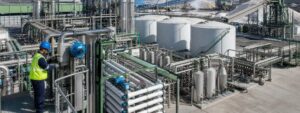
Imagine building a chemical plant like you build with LEGO® blocks—fast, flexible, and tailored to your needs. That’s what a modular manufacturing system offers. It’s not a trend, it’s a strategic response to today’s industrial demands.
At its core, this system means using standardized, preassembled modules—each with specific functions—that can be combined and scaled based on production requirements. Whether you need a compact chlorine plant or a decentralized hydrogen station, modular manufacturing turns vision into reality without the massive investment or long delays.
More than a construction method, it’s a mindset: flexibility over rigidity, speed over tradition, and adaptability over size.
The Rise of Modular Plants in the Chemical Industry
Why is everyone—from salt producers to industrial giants—suddenly interested in modular plants?
Because they’re practical.
The traditional model of centralized mega-factories is hitting limits. Global supply chain fragility, volatile energy costs, and evolving environmental regulations demand a different approach. Enter modular systems.
Since 2020, we’ve seen a significant shift toward decentralized, small-to-mid volume production, especially in sectors dealing with specialty chemicals, water treatment, and energy carriers like hydrogen and ammonia. Companies are seeking shorter time-to-market, less capital exposure, and better scalability. Modular manufacturing delivers on all fronts.
In many industries, it’s no longer a question of if—but when modular will be the new normal.
Key Components of a Modular Manufacturing System
Modular Fabrication and Construction
This involves creating pre-fabricated process units offsite—fully piped, wired, and tested—then assembling them on location. Think plug-and-produce. The result? Less on-site labor, faster deployments, and tighter quality control.
Modular Design and Standardization
Beyond construction, design modularity ensures components are interchangeable, replicable, and easy to scale. It reduces engineering costs, allows design reusability, and supports future expansion.
Distributed and Scalable Production Units
Multiple smaller units, sometimes geographically dispersed, work in parallel. You can add or remove capacity based on market needs, or relocate modules where the opportunity is stronger. It’s production that follows demand, not the other way around.

When Modular Manufacturing Makes the Most Sense
Not every process needs to be modular. But when these conditions apply, modularity is a game-changer:
Low-to-Mid Volume, High-Value Production
Think specialty chemicals, electrolysis byproducts, or pharmaceutical intermediates. These products don’t justify huge factories—but they demand flexible, precise systems.
Volatile or Remote Markets
Geographically spread demand? Seasonal production spikes? Modular plants can be deployed where needed, when needed.
Costly or Hazardous Logistics
Transporting chlorine, hydrogen, or bio-based feedstocks isn’t just expensive—it’s risky. Producing closer to the point-of-use reduces hazards and costs.
👉 Real case: A company with excess salt built modular electrolysis units near demand centers, converting a waste stream into a revenue line with minimal logistic burden.
Why Value Density Determines Deployment Strategy
Why Value Density Determines Deployment Strategy
One term you need to know is value density: the relationship between a product’s market value, logistic cost, and resource availability.
If you have:
- High logistics costs
- Decentralized resource availability
- Medium-to-low throughput needs
…then modular production is your best bet.
It’s not about being trendy—it’s about economically viable deployment. Especially in cases like stranded gas, biomass, or regional chlorine demand, value density is the compass that guides smart decision-making.
WELYSIS MODULAR MANUFACTURING SOLUTIONS
Benefits That Matter: Time, Cost, Safety and Sustainability
Let’s talk numbers:
- 30% faster deployment timelines
- Up to 40% lower capital expenditures
- Lower carbon footprint, thanks to minimized transport and optimized energy use
- Improved safety due to controlled fabrication environments and lower chemical inventory per site
But more than numbers, it’s about peace of mind. Modular plants offer faster return on investment, lower risk exposure, and a scalable path to growth. That’s value you can feel. (Source)
Technical Challenges and Smart Solutions
Of course, modularity isn’t plug-and-play magic. Here’s what to watch out for:
Coordination Between Modules
Distributed units require smart control systems. Modern architectures like Decentralized Intelligence for Modular Applications (DIMA) and digital twins enable real-time optimization and synchronization.
Digital Twins and Remote Monitoring
Modular plants often run remotely, without onsite staff. Predictive maintenance, advanced diagnostics, and AI-powered analytics ensure operational reliability 24/7.
Regulatory and Design Standardization
Deploying modules across borders? Design for the strictest regulation and you’ll reduce risk. Standardization also simplifies approvals and logistics.
The Strategic Role of Modular Systems in Diversification
For many companies, modular production isn’t just about efficiency—it’s about unlocking new revenue models.
For salt producers:
Modular electrolysis transforms excess salt into chlorine and other high-margin products—turning waste into profit.
For chemical distributors:
Owning modular plants means controlling supply, improving quality, and protecting margins in unstable markets.
For industrial conglomerates:
Modular Manufacturing System offers flexible capacity, sellable byproducts, and integration with existing energy assets.
In all cases, modular systems enable decentralized growth with centralized control—a powerful combination.
Real-World Examples and Industry Use Cases
Without naming names, let’s consider:
- Remote hydrogen production in desert environments using containerized electrolysers
- Modular GTL (Gas-to-Liquid) plants unlocking stranded natural gas reserves
- Mobile chlorine production units for water treatment in coastal regions
- Micro ammonia generators deployed near fertilizer markets to bypass import bottlenecks
All of these leverage modular manufacturing to solve real-world problems with elegance and efficiency.
How to Assess if Modular Manufacturing is Right for Your Business
Here’s a quick checklist:
✅ Do you produce low-to-medium volume chemicals with high added value?
✅ Are logistics a bottleneck or cost center?
✅ Do you operate in or near volatile or remote markets?
✅ Is capital risk a concern in your investment committee?
✅ Are sustainability and rapid scalability key to your roadmap?
If you answered yes to any of the above, it’s time to seriously consider modular manufacturing.
Conclusion: Building the Future One Module at a Time
A modular manufacturing system isn’t just a technical upgrade—it’s a strategic transformation.
It lets you adapt faster, scale smarter, and invest safer. It opens the door to distributed growth, to process ownership, and to smarter use of resources.
The future of chemical manufacturing isn’t massive and rigid—it’s modular, smart, and agile.
Let’s talk about how modular manufacturing can transform your operations. Whether you’re dealing with excess salt, volatile markets, or simply ready to scale with less risk—the solution could fit inside a shipping container.