What’s the fastest way to cut disinfectant costs without compromising quality? Let’s explore Sodium Hypochlorite Uses that actually deliver ROI—and pinpoint when switching from delivered bleach to on-site generation truly pays off. First, we need to clarify the most relevant use-cases.
What Is Sodium Hypochlorite and How It’s Made (NaOCl 101)
Sodium hypochlorite, best known as bleach, is produced by reacting chlorine with sodium hydroxide in continuous or batch systems. Commercial strengths typically range from 3 to 20 wt%, shipped in rail cars, tank trucks, totes or drums. These two reactants (chlorine and caustic soda) are co-products of the chlor-alkali process.
A critical property you should factor into your sourcing strategy: hypochlorite degrades over time, faster at higher temperatures and lower alkalinity. That means longer supply chains and warm storage can erode available chlorine before you dose. (This is a key reason many plants move to local or on-site production.)
TL;DR: Sodium hypochlorite is easy to make if you already produce chlorine and caustic exactly what a chlor-alkali plant does. If you don’t, you can still produce NaOCl on site by sourcing Cl₂ and NaOH locally and reacting them under controlled conditions.
Where Sodium Hypochlorite Is Used? (By Industry)
Drinking Water & Wastewater Disinfection
Utilities rely on sodium hypochlorite for primary disinfection, residual protection in distribution, and wastewater effluent polishing. It’s widely accepted sector-wide and supplied in multiple strengths; quality control (pH, temperature, metals) preserves available chlorine.
In practice, hypochlorite is dosed with strict controls on contact time, demand, and residual your SOPs and local regulations take precedence. For surface decontamination in lab or facility contexts, guidance commonly uses ~0.5% available chlorine prepared from household bleach verify your facility’s protocol.
Food & Beverage (Sanitation & CIP)
From open plant cleaning to CIP skids, NaOCl remains a workhorse oxidizing disinfectant. It’s valued for broad antimicrobial efficacy, availability, and cost, provided materials compatibility and rinsing are managed. (If your lines run hot, consider on-site prep of working dilutions to minimize strength loss and chlorate formation.)
Pulp & Paper (Bleaching, Utilities)
Mills use sodium hypochlorite in specific bleaching steps and for utility water treatment (cooling, biofouling control). Process windows vary so align chemical strength, temperature and contact time with your grade targets and environmental permits.
Healthcare & Facility Hygiene
Hospitals and labs use hypochlorite for high-level surface disinfection when properly prepared and applied. Remember the big red lines: never mix bleach with acids or ammonia both can release toxic gases. Store and segregate chemicals in separate secondary containment.
Cooling Towers & Pools
Facilities dose NaOCl to control microbial growth in cooling towers, and pools rely on it for sanitation. Temperature control, dosing accuracy and continuous monitoring protect both efficacy and asset life.
Specialty Uses (Semiconductors, Agriculture Formulations)
Sodium hypochlorite appears in selected semiconductor steps where high purity and tight control are mandatory, and as an active in certain agricultural formulations (pesticides, fungicides, algicides). These niche uses reward on-site prep for tight specs and freshness.
FEWER MILES. LOWER EMISSIONS. SMARTER PRODUCTION. WELYSIS
REQUEST ASSESSMENTSafety & Compatibility Essentials (Read Before You Dose)
- Incompatibilities: Bleach is an oxidizer and incompatible with acids, ammonia, alcohols, and guanidinium salts (among others). Mixing can release chlorine or chloramine gases acutely hazardous to eyes and lungs.
- Storage & Segregation: Keep bleach away from organics and reducing agents; use separate secondary containment and follow your SDS. Store cool and shaded; heat accelerates decomposition.
- Working Solutions: Prepare fresh dilutions and respect your facility’s contact times. An example you’ll see in lab biosafety protocols is ~0.5% available chlorine for biohazard decontamination always confirm with your EHS.
Make or Buy? When On-Site NaOCl (or Full Chlor-Alkali) Wins
If you’re comparing sodium hypochlorite suppliers vs on-site production, focus on four levers:
- Volume & Volatility: Higher, steadier demand increases on-site ROI.
- Logistics Risk: Long hauls + heat = faster strength loss; on-site eliminates transit degradation.
- Spec & Freshness: Tighter specs (metals, pH), high-purity demand, or frequent audits favor local control.
- Sustainability: Cutting transport miles trims Scope 3 emissions, and membrane cells lower energy per ton of product.
Quick Comparison (decision aid)
Demand profile
- Delivered sodium hypochlorite: Low/irregular
- On-site NaOCl / full chlor-alkali: Medium–high, stable
Quality & freshness
- Delivered: Variable with transit time and temperature
- On-site: Consistent; made to spec
Logistics exposure
- Delivered: Supply swings, heat, storage losses
- On-site: Minimal; no long-haul
CAPEX
- Delivered: None
- On-site: Modular; scale by demand
OPEX
- Delivered: Market-driven; transport adds cost
- On-site: Predictable; electricity + salt + utilities
Compliance
- Delivered: Supplier specifications
- On-site: You own validation from cell room to dosing
We like to say it plainly: “I produce hypochlorite where it’s consumed less transport, more control and consistent quality.” And “I scale by modules: one train today, the next when demand requires no oversized CAPEX.”

The Welysis Blueprint: Modular Chlor-Alkali with Membranes
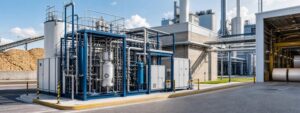
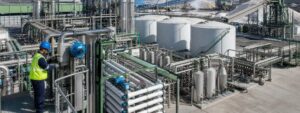
Welysis designs, builds and maintains modular membrane chlor-alkali plants that produce chlorine, caustic soda and hydrogen. From those co-products, we generate sodium hypochlorite on site under tight control of strength, purity and temperature. Plants are energy-efficient thanks to advanced ion-exchange membranes, and the modular architecture speeds deployment and future expansion.
Beyond equipment, **WIN (Welysis International Network)**connects every plant we deploy. I compare my KPIs across twin sites, receive benchmarking-driven tuning, and benefit from predictive maintenance to maximize uptime. “With WIN, I correct before I fail.”
Who benefits most?
- Salt producers turning low-value salt into high-value chlor-alkali products and then into NaOCl for regional markets.
- Chemical distributors securing margins and availability by becoming local producers.
- Large industrial users (water, Oil & Gas, pulp & paper, F&B) who cut chemical OPEX and sell excess.
- Investors seeking bankable, sustainable assets with modular growth.
Sodium Hypochlorite Manufacturing: Practical Notes for Plant Teams
- Feed quality matters: Purified brine and correctly conditioned caustic minimize side reactions and metals contamination.
- Temperature control: Keep bulk NaOCl cool (<38 °C/100 °F) heat accelerates decomposition.
- pH window: Maintain high pH during storage to stabilize available chlorine; monitor routinely.
- Materials & hygiene: Select compatible materials and prevent back-contamination from process lines; validate with your SDS.
FAQs: Concentrations, Handling & On-Site Generation
What are the most common sodium hypochlorite uses?
Drinking water and wastewater disinfection, food & beverage sanitation, pulp & paper bleaching, healthcare hygiene, cooling towers and pools; plus niche uses in semiconductors and agriculture formulations.
How is sodium hypochlorite manufactured?
By reacting chlorine with sodium hydroxide; common strengths are 3–20 wt%. Plants do this continuously or in batch.
What concentration should I use for surfaces?
Facility protocols vary by setting and target organism. A frequently cited lab example is ~0.5% available chlorine for biohazard cleanup follow your EHS or public-health guidance.
What should I never mix with bleach?
Never mix with acids or ammonia; both can release toxic gases. Store bleach separately from incompatible chemicals and use secondary containment.
Delivered sodium hypochlorite vs on-site generation, how do I decide?
If your consumption is moderate-to-high, supply routes are long/hot, or you need freshest, tightly specified product, on-site often wins on quality, control and total cost. Modular membrane chlor-alkali lets you start small and expand as demand grows.
Wrap-Up
You’ve seen the uses of sodium hypochlorite across water, industry and facilities and why on-site production can beat hunting for the lowest quote from sodium hypochlorite suppliers. With Welysis you combine scalable membrane technology with the WIN network for ongoing optimization: produce locally, control quality, and turn chemical dependence into productive independence.