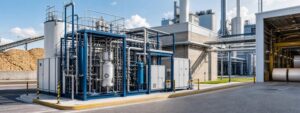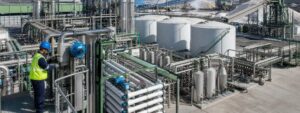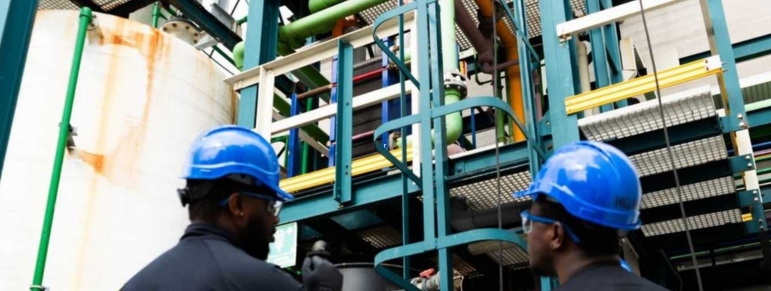
Industrial water treatment systems are usually explained as a mix of filters, pumps, tanks, membranes, dosing units and control panels. That description is correct, but it misses the part that often causes the biggest problems in real industrial operations.
A water treatment system does not depend only on equipment. It also depends on the chemicals that keep that equipment working every day. When chlorine, sodium hypochlorite, caustic soda or other critical chemicals become more expensive, arrive late or vary in quality, the whole operation can be exposed.
This is where many companies discover a hard truth. The risk is not always inside the treatment plant. Sometimes the risk is outside, in the supply chain.
For an industrial company, water treatment is not just about clean water. It is about production continuity, safe operation, regulatory compliance, equipment protection and predictable costs. A good system should not only treat water. It should help the business stay in control.
The important question is not only “Which industrial water treatment system do we need?” The better question is “How much control do we have over the chemicals our system depends on?”
What industrial water treatment systems actually do
Industrial water treatment systems are used to make water suitable for a specific industrial purpose. That purpose can change a lot from one plant to another.
Some companies need water for boilers. Others need it for cooling towers, cleaning, rinsing, food production, chemical processes, mining, energy generation, manufacturing or wastewater discharge. In each case, the water must meet a certain quality level before it can be used safely.
A plant may need to remove suspended solids, hardness, bacteria, oils, metals, salts or organic matter. It may also need to adjust pH, prevent corrosion, avoid scale, disinfect water or prepare wastewater for reuse.
That is why there is no single standard system that works for every plant. Industrial water treatment depends on the source water, the process, the equipment, the required water quality and the risks the company wants to avoid.
This is also why a generic approach can become expensive. A plant does not need the most complex system. It needs the right system for its process, its risks and its future demand.
The part many companies overlook
When companies evaluate industrial water treatment systems, they often focus on visible assets. They compare equipment, capacity, footprint, installation time and maintenance.
All of that matters. But the daily performance of the system often depends on something less visible: chemical availability.
Many treatment processes need chemicals to work well. Chlorine and sodium hypochlorite are widely used for disinfection. Caustic soda is used to adjust pH and support many chemical processes. Other chemicals help with coagulation, flocculation, corrosion control, scale prevention or wastewater treatment.
If those chemicals are always available, stable in price and consistent in quality, they are easy to ignore. But when supply becomes unstable, they become a boardroom issue.
A delayed delivery can affect treatment performance. A sudden price increase can damage margins. A quality variation can force operators to adjust dosing. A shortage can stop production or create compliance risk.
That is why chemical supply should not be treated as a simple purchasing task. In many industrial plants, it is part of operational resilience.
BUILD A MORE FLEXIBLE CHLOR ALKALI PLANT WITH WELYSIS
REQUEST ASSESSMENTWhy chemical dependence becomes a business risk
Chemical dependence becomes a risk when the plant cannot operate normally without external supply.
At first, buying chemicals from third parties can feel convenient. The company does not need to produce them. It does not need to manage that part of the process. It simply orders, stores and uses them.
But convenience has a cost.
The company depends on supplier capacity, transport, energy prices, raw material availability, logistics, storage conditions and market demand from other sectors. If one link in that chain fails, the plant may have very little room to react.
This risk is higher when the chemical is critical, used in large volumes or needed every day. It is also higher when there are few reliable suppliers, long transport distances or strict storage and safety requirements.
For a plant manager, the real pain is not only the price of the chemical. It is the lack of control. It is not knowing whether the next delivery will arrive on time. It is not knowing whether the cost will stay within budget. It is not knowing whether the quality will remain stable.
That uncertainty creates pressure across the business. Operations worries about continuity. Finance worries about margins. Technical teams worry about performance. Management worries about risk. (source)
The real cost of industrial water treatment
The cost of an industrial water treatment system is not only the purchase price of the equipment. The real cost appears over time.
A plant must consider energy consumption, maintenance, spare parts, chemical dosing, monitoring, waste disposal, water discharge, operator time and downtime risk. It must also consider the cost of poor decisions.
If boiler feed water is not treated correctly, scale and corrosion can reduce efficiency and damage equipment. If cooling tower water is not controlled, the plant may face fouling, biological growth, corrosion and higher water use. If wastewater treatment is poorly designed, the company may face compliance problems, disposal costs or production limits.
In many cases, chemicals are one of the recurring costs that keep the system running. That is why price volatility matters. A low equipment price does not help much if the system creates long term dependence on expensive or unstable chemical supply.
A better way to evaluate cost is to ask what the system does to the business over five or ten years. Does it reduce uncertainty? Does it protect production? Does it make costs more predictable? Does it reduce dependence? Does it help the company scale?
If the answer is no, the system may be technically correct but strategically weak.

Why water treatment is linked to production continuity
In an industrial plant, water treatment is rarely isolated. It is connected to production.
If water quality changes, the process can suffer. If treatment stops, production may slow down or stop. If chemicals are not available, operators may need emergency adjustments. If wastewater cannot be discharged or reused, the plant may face bottlenecks.
This is especially important in sectors where water is used continuously. A cooling system cannot simply wait for better supply conditions. A boiler cannot ignore water quality. A wastewater system cannot bypass compliance. A disinfection process cannot operate without the right chemical control.
That is why industrial water treatment must be planned as part of the plant’s operating model. It should be designed not only for normal days, but also for difficult days.
The best systems are not only efficient when everything goes well. They are resilient when something changes.
The role of chlorine, sodium hypochlorite and caustic soda
Chlorine, sodium hypochlorite and caustic soda are especially important because they are linked to essential treatment tasks and broader industrial processes.
Chlorine and sodium hypochlorite are commonly used for disinfection. They help control microbiological risk in water and wastewater systems. Sodium hypochlorite is also valued because it can be easier to handle than some alternatives, depending on the application and site conditions.
Caustic soda is widely used for pH correction, neutralisation and several process applications. It is also connected to the production of other chemicals and industrial treatment needs.
The issue is not that these chemicals are unusual. The issue is the opposite. They are widely used, which means many sectors compete for them. When supply conditions change, water treatment users may be affected by demand from other industries.
For companies that rely on these chemicals every day, this creates a simple strategic question: should a critical input remain completely outside their control?
Local production changes the conversation
Local production of critical chemicals can change the way a company manages industrial water treatment.
Instead of depending fully on external supply, the company can produce key chemicals closer to the point of use. This can reduce exposure to transport delays, price volatility and supplier availability. It can also improve control over quality and production planning.
This does not mean every company should build a large chemical plant. That would not make sense for many operations. The key is modularity.
A modular chlor alkali plant allows a company to start with a capacity that fits real demand and scale when needed. This reduces the risk of overinvestment and makes the business case easier to defend internally.
The value is not only technical. It is strategic.
The company moves from buying a critical input to controlling a critical input. That shift can improve cost predictability, supply security and operational confidence.
When buying chemicals still makes sense
Producing chemicals locally is not always the right answer. A serious industrial decision should admit that from the start. If a company uses small volumes, has reliable local suppliers, faces low price volatility and does not consider the chemical critical, buying from the market may be enough.
There is no need to overcomplicate a simple situation. But the decision changes when the chemical is used every day, when volume is significant, when the plant cannot stop, when price changes affect margin or when logistics create risk. In those cases, the company should not only compare supplier prices. It should compare control models.
The question becomes whether the business wants to keep depending on external availability or whether it can gain an advantage by producing locally.
BUILD A MORE FLEXIBLE CHLOR ALKALI PLANT WITH WELYSIS
REQUEST ASSESSMENTHow to know if your plant has a chemical control problem
A plant may have a chemical control problem if the team spends too much time worrying about supply, cost or quality.
This often appears in small signs before it becomes a major issue. Purchasing starts building larger safety stocks. Operators complain about product variation. Finance struggles to forecast treatment costs. Management asks why margins are being hit by chemical prices. Production teams worry about what would happen if a delivery arrived late.
These signs should not be ignored.
They show that the water treatment system may be technically functional but strategically vulnerable.
A plant has more control when it can forecast cost, secure availability, maintain quality and scale supply with demand. If those four things depend entirely on third parties, the business is exposed.
What a strong industrial water treatment strategy should include
A strong strategy starts with the real needs of the plant. It does not start with a catalogue.
The first step is to understand the water source, the required quality and the process conditions. Water used in a boiler has different needs from water used in a cooling tower or wastewater reuse system. The system must match the use case.
The second step is to understand the risks. The plant should know what happens if water quality changes, if chemicals are delayed, if energy costs rise or if discharge limits become stricter.
The third step is to understand long term cost. The cheapest system at the beginning is not always the most profitable system over time. A plant should look at chemical consumption, energy use, maintenance, waste, downtime and scalability.
The fourth step is to evaluate control. This is where many companies find the biggest opportunity. If the plant depends on recurring volumes of critical chemicals, local production may offer more value than another round of supplier negotiation.
The fifth step is to choose a partner, not just a vendor. Industrial water treatment affects the plant for years. The company needs engineering, commissioning, operation support, maintenance and a clear path for future expansion.
Water reuse adds another reason to think differently
Water reuse is becoming more important in industrial operations. Water scarcity, discharge limits, expansion plans and sustainability goals are pushing companies to recover and reuse more water.
This can be a strong business move. Reusing water can reduce fresh water consumption, lower wastewater volumes, protect the plant from supply restrictions and support environmental goals.
But water reuse also raises the bar. The treated water must be reliable enough for its next use. That means the system must be designed with the right treatment steps, monitoring and operational discipline.
In some cases, reuse systems combine biological treatment, filtration, reverse osmosis, UV disinfection, chemical treatment or other technologies. The exact design depends on the type of wastewater and the quality required.
Again, the lesson is the same. Equipment matters, but control matters more. If reuse becomes part of production, the treatment system becomes part of business continuity. (source)
Why modular systems reduce decision risk
Industrial projects often slow down because the investment feels too large or too uncertain. Operations may like the idea, but finance asks for payback. Engineering may support the concept, but management worries about complexity. The board may see the opportunity, but nobody wants to approve an oversized project.
Modularity helps solve this problem.
A modular system allows the company to start with a realistic capacity and expand later. This makes the decision easier to justify because the investment follows demand. It also reduces the risk of building too much too soon.
For chemical production, this is especially important. A company may want more control, but it may not want to take on the risk of a large traditional plant. A modular chlor alkali solution creates a more practical path.
It gives the company a way to produce critical chemicals locally, improve resilience and scale over time.
A better way to choose industrial water treatment systems
The usual way to choose industrial water treatment systems is to compare technologies. That can be useful, but it is not enough. A better approach is to compare outcomes.
Will the system protect production? Will it reduce downtime risk? Will it help control chemical costs? Will it make water quality more predictable? Will it reduce dependence on external suppliers? Will it support future growth?
These questions are more useful than asking only about technical specifications. A plant does not buy water treatment because it wants equipment. It buys water treatment because it wants stable operations, safe processes, compliance and cost control. The best decision is the one that makes the plant stronger.
The checklist decision makers should use
Before investing in a new system or upgrading an existing one, decision makers should review their current exposure.
The first question is whether the plant depends on critical chemicals that are purchased externally. If the answer is yes, the next question is whether those chemicals have shown price volatility, delivery risk or quality variation.
The plant should also calculate how much downtime would cost if water treatment failed. This number often changes the conversation. A chemical that looked like a purchasing detail suddenly becomes a strategic input.
It is also important to review storage requirements, safety procedures, transport costs, supplier concentration and future demand. If the company expects to grow, the system must be able to grow with it.
Finally, the company should ask whether local production could reduce risk or improve margin. If the answer is yes, it is worth building a business case.
The Welysis perspective
Welysis is built around a clear idea: companies should not depend completely on external suppliers for chemicals that are critical to their operations.
This is not about selling equipment for the sake of equipment. It is about helping industrial companies gain control over supply, cost and production continuity.
Through modular chlor alkali plants, Welysis helps companies produce key chemicals such as chlorine, sodium hypochlorite and caustic soda closer to where they are needed. The goal is to reduce dependence, improve cost predictability and give the plant a more secure operating model.
For companies with recurring chemical demand, this can be more than a technical upgrade. It can become a business advantage.
A plant that controls critical chemical supply has more room to plan. It is less exposed to market shocks. It can protect margin more effectively. It can make decisions with more confidence.
FAQs
What are industrial water treatment systems used for?
Industrial water treatment systems are used to prepare water for industrial processes, protect equipment, treat wastewater and support reuse. They help companies meet quality, safety and regulatory requirements while keeping operations stable.
Why are chemicals so important in industrial water treatment?
Many treatment processes depend on chemicals for disinfection, pH control, corrosion prevention, scale control and wastewater treatment. If those chemicals are delayed, expensive or inconsistent, the system can become harder to operate.
When should a company consider producing chemicals locally?
A company should consider local production when it uses critical chemicals every day, faces price volatility, depends on long supply chains or cannot afford operational interruptions. Local production can make costs and availability more predictable.
Are modular chlor alkali plants only for large industrial groups?
No. A modular approach allows companies to start with the capacity they need and scale later. This makes the investment easier to align with real demand.
What is the main benefit of controlling chemical supply?
The main benefit is operational confidence. When a company controls critical chemical production, it reduces dependence on external suppliers and gains more control over cost, quality and availability.
Industrial water treatment systems are not only about treating water. They are about controlling the conditions that keep a plant running.
Equipment is important, but equipment alone does not solve the full problem. If the system depends on critical chemicals, the company must also think about supply, cost, quality and availability.
This is where many industrial companies can improve their position. Instead of accepting chemical dependence as normal, they can evaluate whether local production gives them more control.
For plants that rely on chlorine, sodium hypochlorite or caustic soda, the opportunity is clear. The next step is not just to buy a better water treatment system. The next step is to build a more controlled, predictable and resilient operation.
Welysis helps industrial companies move in that direction with modular chlor alkali plants designed to secure supply, control costs and support long term industrial growth.