The pulp and paper industry depends on caustic soda more than many people outside the mill realise. It is not just another chemical stored in a tank. It is part of the process that turns wood, recycled fibres and alternative raw materials into usable pulp and paper.
That creates a simple problem.
When a paper mill depends on external suppliers for a chemical that touches pulping, bleaching, deinking and wastewater treatment, the risk is not only about price. It is about control.
A delayed truck can become a production issue. A price spike can become a margin issue. A shortage can become a boardroom issue. And when a critical input stops being available at the right time, the whole operation feels it.
This is why local caustic soda production is becoming a serious question for pulp and paper companies. Not because every mill should produce every chemical it uses. But because some chemicals are too important to leave entirely in the hands of the market.
By the end of this article, you will have a clear way to assess whether caustic soda is still just a purchasing item for your mill, or whether it has become a strategic dependency worth controlling.
Caustic soda is a critical input in the pulp and paper industry
Caustic soda, also known as sodium hydroxide or NaOH, is one of the key chemicals used in pulp and paper manufacturing.
Its main value is easy to understand.
Wood and plant fibres contain cellulose, which is the useful part for paper production. They also contain lignin, which works like a natural glue. To make pulp, the mill needs to separate the fibres and remove enough lignin without damaging the quality of the cellulose.
Caustic soda helps make that possible.
It is used in several parts of the pulp and paper process. It supports chemical pulping. It helps remove lignin. It plays a role in bleaching. It helps separate ink from recovered paper. It also supports pH control and wastewater treatment.
That means NaOH is not a minor input. It is a chemical that appears at several points where quality, continuity and operating cost are at stake.
For a mill manager, this changes the question.
The question is not only “How much caustic soda do we need?”
The better question is “What happens if we do not have it when production needs it?”
Where sodium hydroxide is used in paper and pulp production
Caustic soda appears across the mill in different ways.
Caustic soda appears across the mill in different ways.
Process
Role of sodium hydroxide
Why it matters
Kraft pulping
Helps form white liquor with sodium sulfide
Supports lignin removal and strong pulp
Soda pulping
Acts as the main active chemical
Makes certain soda pulp production possible
Bleaching
Helps remove oxidised lignin
Supports brightness and paper quality
Deinking
Helps separate ink from recovered fibres
Improves recycled paper output
Wastewater treatment
Adjusts pH and neutralises acidic streams
Supports compliance and process stability
Process cleaning
Helps remove organic deposits and residues
Protects operating efficiency
This is why caustic soda cannot be treated like a simple consumable. A pulp and paper mill does not only buy sodium hydroxide. It buys continuity, quality and process stability.
When the supply is external, that stability depends on someone else.
Why NaOH affects quality, continuity and operating cost
In paper production, chemistry and economics are connected.
If the NaOH supply is unstable, the mill may need to hold more inventory. If pricing moves sharply, cost forecasts become weaker. If transport is delayed, operations teams may need to change production schedules or manage emergency supply.
The cheapest tonne on paper is not always the cheapest tonne in real life.
When a mill needs urgent product, the available tonne is the valuable tonne. When the delivered cost includes freight, storage, handling and risk, the invoice price tells only part of the story.
That is why the pulp and paper industry needs to look at caustic soda as a strategic input, not only as a procurement category.
How caustic soda works in the pulp and paper process
The pulp and paper process can look complex from the outside, but the role of caustic soda can be explained in a simple way.
It helps separate what the mill wants from what the mill needs to remove.
The useful part is cellulose fibre. The part that often needs to be removed or reduced is lignin. Caustic soda helps break the structure around those fibres so the mill can produce pulp with the right strength, brightness and cleanliness.
This role changes depending on the process.
Kraft pulping and white liquor
Kraft pulping is one of the most important processes in the pulp industry. In this method, wood chips are cooked in white liquor. White liquor is a solution that contains sodium hydroxide and sodium sulfide.
The purpose is to dissolve lignin and release cellulose fibres.
The process is widely used because it can produce strong pulp. That is important for packaging, tissue, printing papers and many other paper grades.
Many Kraft mills recover a large part of their chemicals through internal recovery systems. That is a major advantage. But recovery is not perfect. Chemical losses still happen. Fresh caustic soda or related chemicals are still needed to maintain the cycle and support stable operation.
This fresh input is often called make up chemical.
For an integrated mill, local production may not mean replacing the whole chemical recovery system. It may mean covering the make up requirement, supporting bleaching demand or creating strategic backup capacity.
That is a very different decision. And it is often easier to evaluate.
Soda pulping and the soda pulping process
Soda pulping deserves special attention because it depends directly on sodium hydroxide.
The soda pulping process uses caustic soda as the main active chemical for delignification. It is often used with certain hardwoods and non wood fibres such as straw, bamboo, bagasse or other agricultural residues.
In this case, caustic soda is not just one chemical among several. It is the core chemical that makes soda pulp production viable.
That matters for any company exploring alternative fibres or more flexible raw material strategies.
If the cost or availability of NaOH changes, the economics of soda pulping can change quickly. A mill that depends on the market for every tonne of caustic soda has less control over the final cost of its soda pulp.
The same logic applies to soda paper applications where the quality and cost of the pulp depend strongly on stable sodium hydroxide supply.
For mills considering alternative fibres, local caustic soda production can become more than a cost project. It can become a way to protect a whole production strategy.
Bleaching, deinking and wastewater treatment
Caustic soda also plays an important role after pulping.
In bleaching, NaOH helps remove oxidised lignin and neutralise acidic compounds. This supports brightness, cleanliness and final paper quality.
In recycled paper production, caustic soda supports deinking. It helps swell fibres and separate inks, adhesives and resins from recovered paper. This is especially relevant as recycled paper and packaging continue to grow in importance.
In wastewater treatment, caustic soda helps control pH and neutralise acidic streams. That supports environmental compliance and keeps treatment systems stable.
So the same chemical can support production, quality, recycling and compliance.
That is useful. But it also increases dependency.
PRODUCE CAUSTIC SODA ON SITE WITH A FLEXIBLE CHLOR-ALKALI PLANT
REQUEST A PROJECT ASSESSMENTThe hidden risk behind external caustic soda supply
Buying caustic soda from the market looks simple until something goes wrong.
A supplier increases the price. A shipment is delayed. Freight costs rise. Product allocation changes. A plant shutdown affects regional supply. Energy prices move. Chlorine demand shifts and caustic soda pricing follows.
The mill may have done nothing wrong. Yet its cost base changes.
That is the problem with chemical dependency.
It turns an internal production need into an external risk.
Price volatility in a co product market
Caustic soda is produced through the chlor alkali process. This process also produces chlorine and hydrogen.
That means caustic soda pricing does not depend only on paper industry demand. It is also influenced by chlorine demand, energy costs, regional production balances and logistics.
A pulp and paper mill can have stable demand for NaOH while market prices move for reasons that have little to do with paper.
That creates a difficult position for procurement and finance teams.
They need predictable costs. The market gives them a moving target.
For high volume users, this can directly affect pulp costs, paper pulp pricing and operating margin.
The logistics problem of transporting liquid caustic soda
Liquid caustic soda is commonly supplied in concentrated solution. That makes handling easier for many users, but it creates a clear logistics issue.
A mill is not only paying to move sodium hydroxide. It is also paying to move water.
For mills located far from chemical production hubs, this can become a heavy cost. Freight, storage, safety handling and inventory planning all become part of the real delivered cost.
This is where many purchasing comparisons become too narrow.
The question is not only “What is the price per tonne?”
The stronger question is “What is the full delivered cost of dependency?”
That includes transport, waiting time, emergency supply, stock levels, safety stock and the cost of disruption.
Why supply delays can become production delays
A pulp and paper mill is designed for continuity.
When critical chemicals are late, operations teams lose flexibility. They may need to reduce output, delay a production run, change grade planning or use more expensive emergency supply.
In the worst case, a missing chemical input can stop production.
That is why caustic soda supply is not only a purchasing concern. It is an operational risk.
For the operations team, the fear is practical. The plant cannot depend on perfect logistics forever.
For the finance team, the concern is different. Every disruption has a cost.
For the leadership team, the issue is strategic. If an input can affect continuity, margin and customer commitments, it deserves more control.
When buying caustic soda becomes a margin problem
A chemical becomes a margin problem when it is critical, consumed regularly and exposed to price or supply uncertainty.
Caustic soda fits that description in many pulp and paper mills.
It may be bought as a commodity, but it behaves like a strategic input. It affects cost. It affects process stability. It affects quality. It affects risk.
This is why local production should not be evaluated only as a technical project. It should be evaluated as a business case.
A realistic cost example for a pulp and paper mill
Let’s use a simple example.
Imagine a pulp and paper mill producing 500 tonnes of market pulp per day.
If the mill consumes around 35 kg of caustic soda per tonne of pulp, daily consumption would be about 17,500 kg of NaOH.
Over a full year of continuous operation, that is roughly 6,400 tonnes.
If the market price ranges from 400 to 600 USD per tonne (on a 100% NaOH basis), the annual caustic soda spend can sit between 2.5 and 3.8 million USD before considering hidden logistics and risk costs.
At that scale, caustic soda is not a small purchasing detail.
It is a cost line that deserves board level attention.
And if the mill is far from supply points, exposed to freight volatility or dependent on emergency stock, the real impact can be higher than the invoice suggests.
Why delivered cost matters more than price per tonne
The price per tonne is useful. But it is not enough.
A serious comparison should include:
Cost factor
Why it matters
Product price
The visible purchase cost
Freight
Often a major part of delivered cost
Storage
Tanks, safety stock and inventory management
Handling
Safety, labour and internal procedures
Delays
Production risk and emergency sourcing
Price volatility
Forecasting difficulty and margin exposure
Quality variation
Process instability and additional controls
Downtime risk
The cost of production interruption
This is where local production can change the conversation.
It does not remove every cost. It changes the cost structure.
Instead of depending on market price plus freight plus supplier availability, the mill can evaluate a model based on salt, water, electricity, maintenance and controlled production.
That can make planning clearer.
Local caustic soda production as an industrial control strategy
Local caustic soda production is not only about making a chemical on site.
It is about taking control of a critical input.
For pulp and paper companies, this can mean lower exposure to logistics, better cost predictability and stronger supply security.
For chemical distributors serving paper mills, it can mean moving from resale to local production and capturing more margin.
For salt producers, it can mean transforming a commodity into higher value chemicals.
The strategic idea is simple.
When you control production, you control more of your growth.

From chemical dependency to controlled production
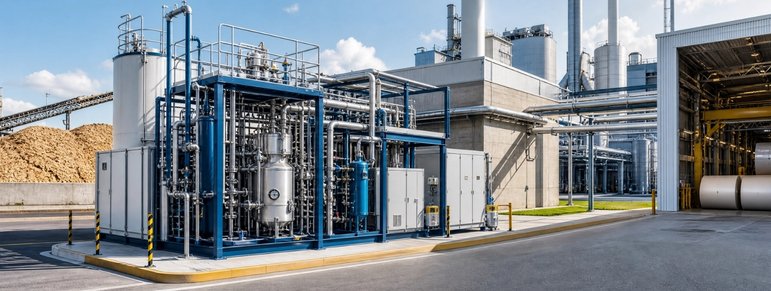
A modular chlor alkali plant can produce sodium hydroxide locally using salt, water and electricity. It can also produce chlorine and hydrogen as part of the same process.
For the pulp and paper industry, the most immediate benefit is supply control.
The mill no longer depends entirely on external caustic soda availability. It can produce according to its own demand profile, subject to plant capacity and operating plan.
That does not mean every mill should stop buying caustic soda overnight.
A realistic first step may be to produce part of the demand locally. For example:
Starting point
Why it can make sense
Make up chemicals
Useful for Kraft mills with recovery systems
Bleaching demand
Relevant where NaOH use is predictable
Strategic backup
Reduces exposure to supply disruption
Remote sites
Reduces freight and delivery risk
Local production turns caustic soda from a volatile purchase into a controlled industrial capability. That is the real shift.
Why modular chlor alkali plants reduce the entry barrier
One of the biggest objections is size.
Many industrial buyers assume chlor alkali production is only for very large chemical companies. That belief can stop the conversation before the numbers are even analysed.
Modular production changes that. A modular plant can be designed around real demand. It can start with a capacity that matches the mill’s current needs and scale as demand grows or the business case improves.
This matters because oversizing is one of the fastest ways to weaken an industrial project. The goal is not to build the biggest possible plant. The goal is to build the right plant for the site.
For a paper mill, that may mean starting with a limited scope. For a distributor, it may mean serving a local customer base with reliable supply. For a salt producer, it may mean creating a first industrial step into higher value chemistry.
The logic is the same. Start with demand. Build around it. Scale with evidence.
The role of chlorine and hydrogen co products
The chlor alkali process does not only produce caustic soda. It also produces chlorine and hydrogen. This can improve the business case if the site has a use for those streams. In some pulp and paper operations, chlorine can be used to produce sodium hypochlorite for water treatment or sanitation applications, depending on site needs and regulatory conditions.
Hydrogen may also have value, depending on local energy strategy, industrial demand or future integration options. These co products should not be treated as automatic revenue. That would be too simplistic. They should be evaluated properly.
The strongest business case is built on real demand, real cost, real site conditions and a conservative view of what the plant can use or sell.
What paper mills should evaluate before producing caustic soda locally
Local production can be attractive, but it is not a shortcut.
It requires investment. It requires engineering. It requires safety planning. It requires permits. It requires a clear view of electricity cost. It requires maintenance, training and integration with the existing operation.
Putting those issues on the table early does not weaken the idea.
It makes the decision stronger.
CAPEX, electricity cost and payback
The first concern is usually investment.
That is normal.
A local production project must be defended with numbers. The business case should compare today’s delivered cost of caustic soda with the expected cost of local production.
The model should include:
Variable
Why it matters
Current annual NaOH consumption
Defines demand and plant sizing
Delivered caustic soda cost
Shows the real baseline
Electricity price
A major operating cost in electrolysis
Salt cost and availability
Affects production economics
Water availability
Needed for process operation
Maintenance cost
Protects long term reliability
Labour and training
Impacts daily operation
Storage and handling
Still needed, but under more control
Co product use
Can strengthen or weaken the case
Downtime cost
Shows the value of supply security
A good feasibility study should test several scenarios. Conservative. Expected. Stress case. That is how a project becomes defendable in front of finance and leadership.
Permits, safety and operational integration
Safety and permits are not small details.A chlor alkali plant must be designed, installed and operated with proper industrial discipline. The project needs clear procedures, trained teams, monitoring, maintenance and compliance planning.
This is where supplier choice matters. The wrong approach is to buy equipment and leave the mill to manage the complexity alone. The right approach is to integrate the plant into the operation with engineering, commissioning, training, support and performance monitoring.
For Welysis, this is where the value goes beyond equipment. The project is not only a plant. It is a production capability that needs to work safely and reliably over time.
Make up chemicals, bleaching demand and strategic backup capacity
Many mills do not need to begin with full replacement. That point is important. A Kraft mill may start by evaluating make up chemical demand. A bleaching operation may evaluate a dedicated supply model. A remote site may evaluate local production as backup capacity. A non integrated facility may explore a larger share of internal production.
This staged approach reduces risk. It also makes internal approval easier because the project can be linked to a specific operational pain. Instead of asking the board to approve a broad transformation, the team can ask a better question:
Can we reduce our most exposed caustic soda dependency with a modular, measurable and scalable project?
That is a stronger conversation.
Practical checklist for pulp and paper companies
Before requesting a generic quote, a mill should assess its dependency. This checklist can help.
Question
Why it matters
Do we consume caustic soda every day?
Stable demand improves the case
Is NaOH critical to production continuity?
Critical inputs need more control
Are we far from chemical production hubs?
Distance increases freight and risk
Have we suffered delivery delays?
Past disruption reveals exposure
Has price volatility affected margins?
Cost swings can justify control
Do we use chlorine based chemicals too?
Co-products may add value
Do we hold high safety stock?
Inventory hides dependency cost
Do we need better cost predictability?
Local production can support planning
Can we access competitive electricity?
Power cost affects economics
Could we start with make up or bleaching demand?
Smaller scope can reduce risk
Do we need a clear case for management?
ROI and risk reduction must be measurable
If several answers are yes, local caustic soda production is worth evaluating. Not buying immediately. Evaluating. That distinction matters.
When a feasibility study makes sense
A feasibility study makes sense when the cost of dependency is visible or suspected.
It should answer practical questions.
- How much caustic soda does the mill really consume each year?
- What is the delivered cost, not only the purchase price?
- How exposed is the mill to logistics delays?
- What capacity would make sense at the site?
- What would the plant consume in salt, water and electricity?
- What permits and safety measures would be required?
- Could chlorine or hydrogen add value?
- What payback range is realistic?
- What happens if external prices fall?
- What happens if external prices rise?
A good study does not sell optimism. It reduces uncertainty.
That is what industrial buyers need.
Why Welysis fits this problem
Welysis fits this conversation because the real problem is not only chemical supply. The real problem is chemical dependency. A pulp and paper mill does not need another supplier promising availability. It needs a way to reduce exposure to volatility, logistics and margin loss.
Welysis helps industrial companies produce critical chemicals locally through modular chlor alkali plants. The objective is clear: secured supply, predictable costs and more control over production. The value is not only the plant itself.
The value is the industrial capability behind it. Welysis integrates engineering, implementation, operation support and long term optimisation. That matters because paper mills do not want an isolated asset that creates new complexity. They want a reliable production solution that fits the operation.
For a mill, this can mean more resilient caustic soda supply. For a chemical distributor, it can mean capturing industrial margin instead of only reselling product. For a salt producer, it can mean turning raw material into higher value chemicals. For an investor, it can mean building a scalable industrial asset around real chemical demand.
Different profiles. Same logic. If a chemical is critical, control it.
FAQs
Is caustic soda essential in the pulp and paper industry?
Yes. Caustic soda is used in several key stages of pulp and paper production, including pulping, bleaching, deinking and wastewater treatment. It helps remove lignin, control pH and improve fibre processing. For many mills, it is a critical chemical input.
What is the difference between Kraft pulping and soda pulping?
Kraft pulping uses white liquor, which contains sodium hydroxide and sodium sulfide. Soda pulping uses sodium hydroxide as the main active chemical. The soda pulping process is often used for hardwoods and non wood fibres such as straw, bamboo or bagasse.
Can a pulp and paper mill produce caustic soda on site?
Yes, some mills can produce caustic soda locally with a chlor alkali plant using salt, water and electricity. The decision depends on annual consumption, electricity cost, logistics, safety requirements, permits and whether the site can use chlorine or hydrogen co products.
When does local caustic soda production make economic sense?
It usually makes sense to evaluate when the mill has stable demand, high delivered cost, logistics exposure, supply delays or strong need for cost predictability. The decision should be based on a feasibility study comparing external purchase with local production.
Does on site caustic soda production replace chemical recovery?
Not necessarily. In Kraft mills, chemical recovery remains central to the process. Local caustic soda production can support make up chemical needs, bleaching demand or backup capacity rather than replacing the recovery system entirely.
Caustic soda is essential to the pulp and paper industry. It supports Kraft pulping, soda pulping, bleaching, deinking, pH control and wastewater treatment. That makes it valuable. It also makes it risky when the supply is fully external.
For many pulp and paper mills, the future question will not be only how to buy caustic soda at a better price. It will be how to reduce dependency on a chemical that can affect production, quality, margin and customer commitments.
Local production is not the answer for every site. It requires real analysis. It depends on demand, electricity, salt, logistics, permits, safety and payback. But for the right operation, it can turn a volatile purchase into a controlled industrial capability.
Welysis helps companies make that shift with modular chlor alkali production designed around control, scalability and long term operation. If caustic soda is critical to your mill, the next step is not to request a generic price quote.
The next step is to measure your dependency and find out whether local production can protect your supply, your costs and your margin.